01
Sew-through, shank and tack buttons
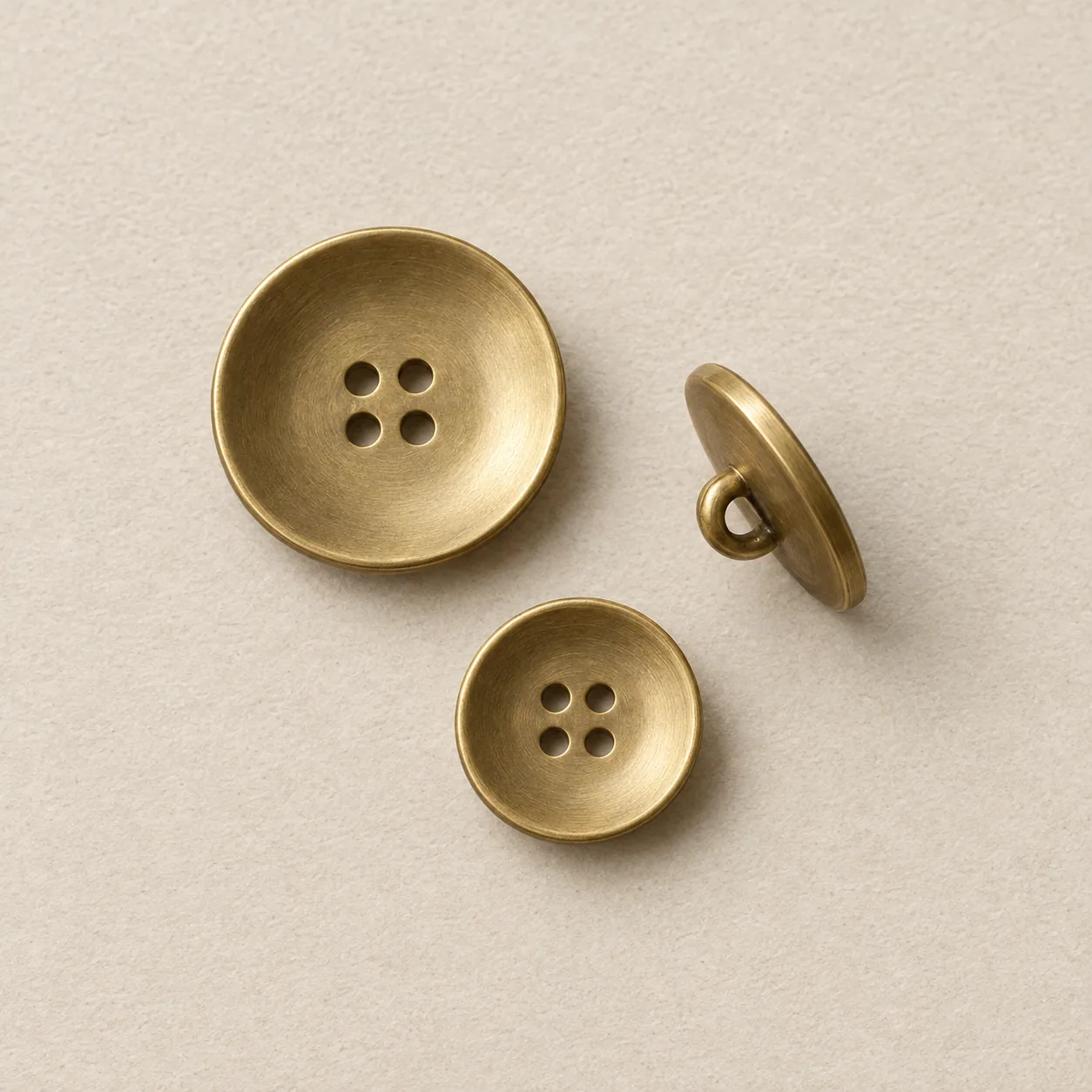
A sew-through button has two or four holes through its face and sits flat on the cloth. A shank button carries a loop or stem on its back, which lifts it clear of thick cloth so the buttonhole can close around it — the usual choice for blazers and coats.
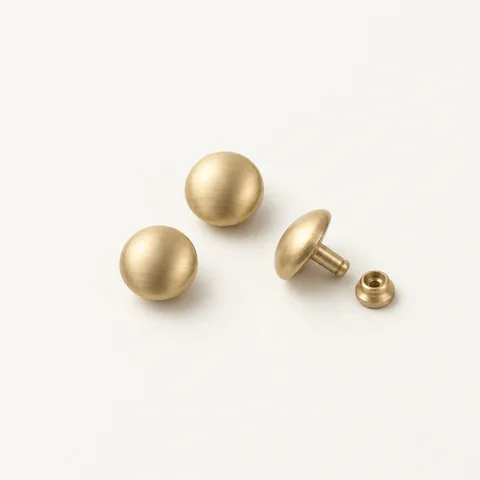
A jeans button uses no thread: a tack is pushed through the cloth from inside and pressed into the button’s hollow stem, so there is no stitching to wear through. The button and its tack are ordered as a pair.
02
Button faces and jeans hardware
Within each fixing, metal buttons differ by face: domed or flat, plain or patterned, rimmed or rimless, in shirt, jacket, blazer and coat styles. Detailed faces are usually die-cast; plain ones are often stamped. Signed in, you can filter the collection by shape, finish and measurements, or start from a photograph.
Jeans pair their buttons with rivets at the pocket corners, both set by press. Snap fasteners — press studs — are a different closure: four parts, a cap and socket on one side of the opening and a stud and post on the other.
03
Button sizes: lignes and millimetres
Buttons are measured across the face, in millimetres or in lignes: one ligne (L) is 1/40 in, or 0.635 mm, so a 24L button is about 15 mm across. Jeans buttons are usually quoted straight in millimetres, and 17 mm and 20 mm are common on waistbands.
For a shank button on thick cloth, give the shank height too; for a jeans button, the tack length, which must suit the thickness of the waistband where it is set.
| Lignes | Across the face | Usually for |
|---|---|---|
| 18L | 11.4 mm (0.45 in) | Shirts, cuffs |
| 24L | 15.2 mm (0.60 in) | Shirts, light jackets |
| 28L | 17.8 mm (0.70 in) | Jackets, trousers |
| 32L | 20.3 mm (0.80 in) | Jackets, coats |
| 40L | 25.4 mm (1 in) | Coats |
04
Materials and finishes
Metal buttons are commonly die-cast in zinc alloy or stamped from brass or steel; which material a given piece is made in is confirmed with your representative. Jeans are usually washed after their buttons are set, so the finish is chosen for the wash the garment will go through.
Across the collection, pieces come plated in six colours: gold, silver, rose gold, gunmetal, black and antique bronze; how each looks and wears is in hardware finishes.
05
Ordering metal buttons
Rayestar supplies companies — garment makers, brands and wholesalers — rather than individuals. Open a trade account and one representative handles your samples, prices and orders.
- Find the button by photo or SKU, and note its size in lignes or millimetres.
- Say how it fixes — sewn through, on a shank or with a tack — and choose the plating colour.
- Give the quantity; your representative confirms price, samples and lead time.
Questions
Questions buyers ask
- What is the difference between a shank button and a sew-through button?
- A sew-through button is stitched through holes in its face and sits flat; a shank button is stitched through a loop on its back, which lifts it above thick cloth.
- What are jeans buttons called?
- Tack buttons: a metal button with a hollow stem, fixed by a tack pressed through the cloth from inside. They need no thread, and the tack’s length is matched to the fabric.
- How are button sizes measured?
- Across the face, in millimetres or in lignes. One ligne is 0.635 mm, so a 24L button is about 15 mm across and a 40L button exactly 1 in.
- What is the difference between a jeans button and a snap fastener?
- A jeans button passes through a buttonhole and is fixed to one side of the opening; a snap fastener has two halves that press together, with no buttonhole.
- What nickel rules apply to metal buttons on clothing?
- In the EU, rivet buttons, rivets and zips used in garments are named among the examples in the nickel restriction: parts in direct and prolonged contact with the skin may release no more than 0.5 µg of nickel per cm² per week, measured by EN 1811. Buyers selling there ask their suppliers for test results.
- Can garment makers order metal buttons in bulk?
- Yes, as companies. Register, have your company details reviewed, and one representative handles samples, prices and orders.
The illustrations show the type, not a specific catalogue piece. Size, material, finish and lead time are confirmed for each order by the representative who handles it.