01
How a cord lock works
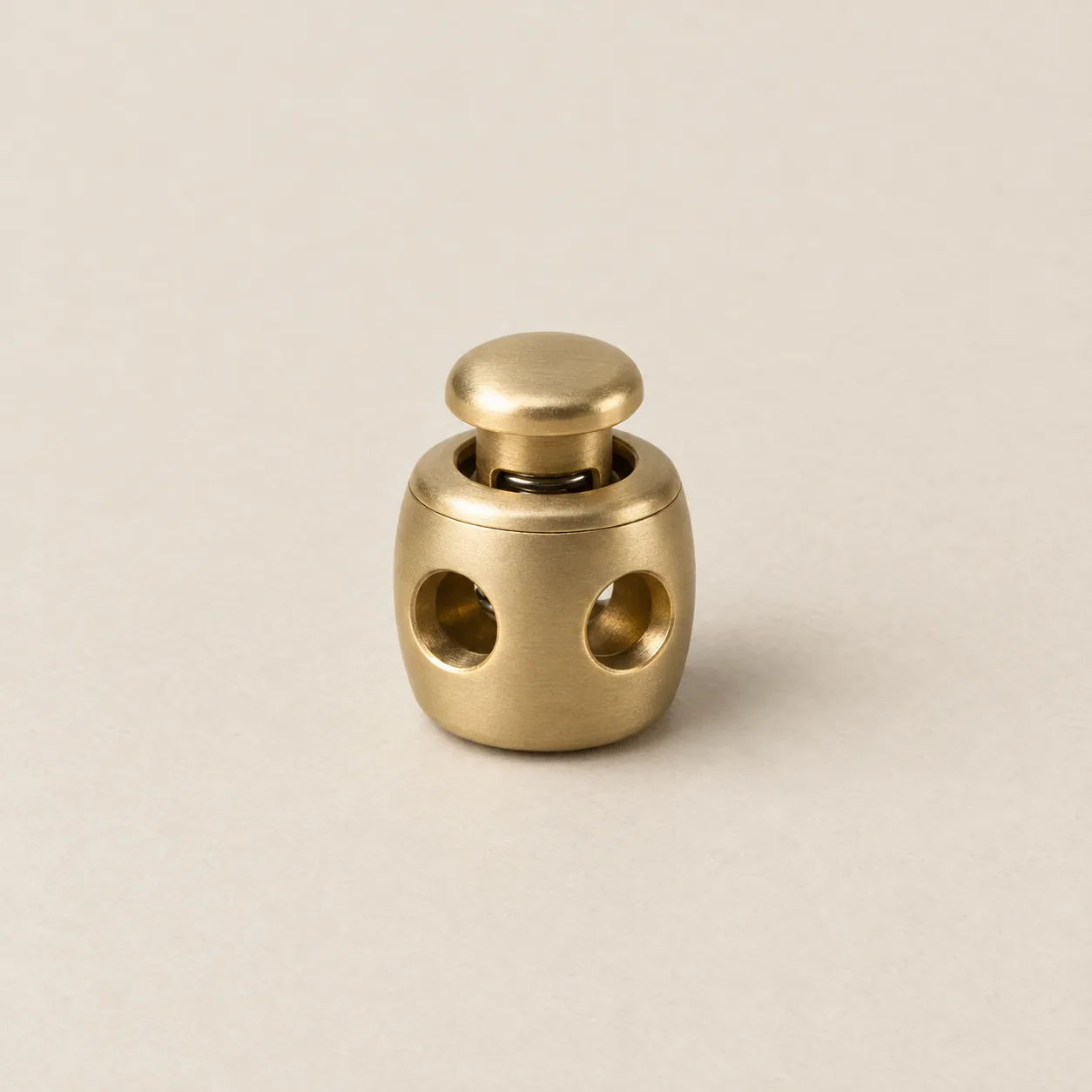
A cord lock has a body, a plunger and a spring between them. Pressing the plunger lines its hole up with the holes in the body, so the cord slides freely; letting go, the spring pushes the plunger back, and the offset holes pinch the cord.
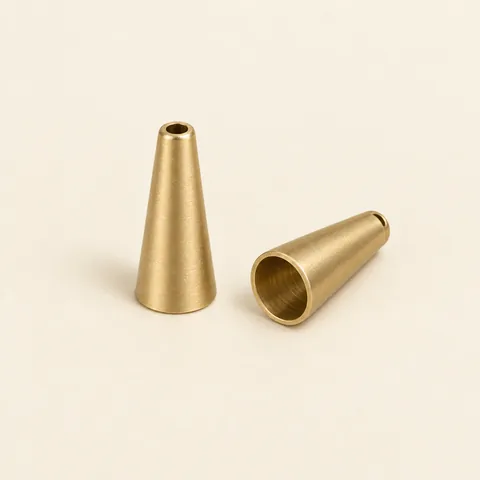
It sits on the cord rather than the garment, so it can be fitted or changed after sewing. The cord leaves the garment through an eyelet or a buttonhole, and a cord end on its tip stops the lock sliding off.
02
Single-hole, two-hole and shaped cord locks
Single-hole locks take one cord, or both ends of a drawcord passed through together. Two-hole locks keep the two ends side by side and apart — the usual finish on a hood or a bag mouth.
Shapes run from round and barrel to oval, flat and square, with plain, ribbed or patterned faces. Metal cord locks suit fashion garments and bags where the hardware is part of the look; plastic ones are the norm on outdoor and sportswear. Signed in, you can filter the collection by shape, finish and measurements, or start from a photograph.
03
Cord lock sizes
A cord lock is named by its hole diameter, which has to take the cord: a 4 mm hole for a 4 mm cord. If both ends of a drawcord pass through one hole, it must take two cords side by side — about twice the cord’s diameter.
Measure the cord you will use, not its label: elastic and braided cords sold as the same size can differ. A flat cord needs a hole or slot as wide as the cord.
| Hole diameter | Nearest inch size |
|---|---|
| 3 mm | 1/8 in (3.2 mm) |
| 4 mm | 5/32 in (4.0 mm) |
| 5 mm | 3/16 in (4.8 mm) |
| 6 mm | 1/4 in (6.4 mm) |
| 8 mm | 5/16 in (7.9 mm) |
04
Materials and finishes
Metal cord locks are commonly die-cast in zinc alloy with a steel spring inside; plastic ones are moulded in acetal (POM) or nylon. On garments that are washed, ask what the spring is made of, because plain steel can rust. Which material a given piece is made in is confirmed with your representative.
Across the collection, pieces come plated in six colours: gold, silver, rose gold, gunmetal, black and antique bronze; how each looks and wears is in hardware finishes.
05
Ordering cord locks
Rayestar supplies companies — garment and bag makers, brands and wholesalers — rather than individuals. Open a trade account and one representative handles your samples, prices and orders.
- Find the cord lock by photo or SKU, and note its hole diameter.
- Give the cord’s diameter and how many cords pass through each hole, and choose the plating colour.
- Give the quantity; your representative confirms price, samples and lead time.
Questions
Questions buyers ask
- What is the difference between a cord lock and a cord stopper?
- There is none: cord lock, cord stopper and toggle stopper name the same sprung part. A cord end is different — it is fixed to the tip of the cord and does not slide.
- What size cord lock do I need?
- One whose hole takes your cord: a 4 mm hole for a 4 mm cord. If both ends go through one hole, choose a hole about twice the cord’s diameter, or a two-hole lock.
- How do you thread a cord lock?
- Press the plunger until the holes line up, push the cord through and let go. A soft or frayed cord threads more easily with its tip wrapped in tape.
- Should I choose a single-hole or a two-hole cord lock?
- A single hole takes one cord, or both ends together; two holes keep the ends side by side and apart, which looks neater on a hood or a bag opening.
- Metal or plastic cord locks?
- Metal where the hardware is part of the look and should match the garment’s other metal; plastic where weight matters, as on outdoor wear. Either way, size it by the hole.
- Can individuals buy cord locks here?
- No. Rayestar supplies companies — garment and bag makers, brands and wholesalers — and one representative handles each account’s samples, prices and orders.
The illustrations show the type, not a specific catalogue piece. Size, material, finish and lead time are confirmed for each order by the representative who handles it.