01
How a side release buckle works
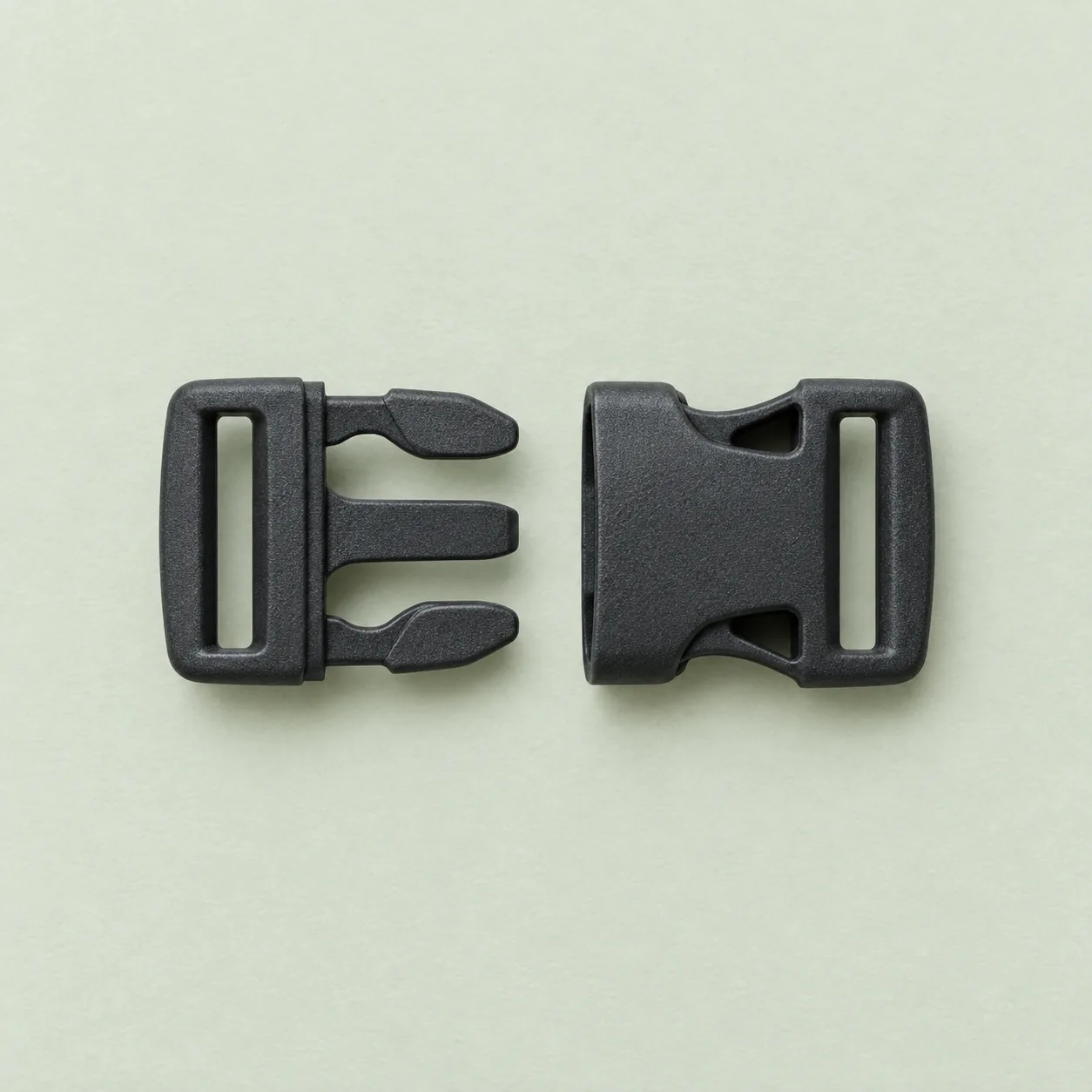
It is made in two halves. The male half carries two sprung prongs either side of a centre guide; pushed into the female housing, the prongs spring out through its side windows and lock. Squeeze them back through the windows and the halves pull apart.
Each half has a bar or slot for webbing. On a single-adjust buckle one end is sewn and the other threads through a bar that sets the length; on a double-adjust buckle both ends adjust.
02
Plastic and metal side release buckles
Plastic side release buckles are the common type: moulded, light, quiet and coloured right through. Metal ones, usually die-cast zinc alloy or aluminium, are plated to match a bag’s other hardware and are chosen where the buckle is on show.
Shapes vary too: flat or contoured to sit round the body, single or double adjust, and mini sizes for small bags and accessories. On packs they often work with ladder lock buckles: the side release opens the strap, the ladder lock sets its length.
03
Side release buckle sizes
A side release buckle is named by the webbing width it takes, not by its length: a 25 mm buckle is for 25 mm webbing, measured inside the strap slot. Check the slot height against the webbing’s thickness too, since thick or doubled webbing may not pass.
| Webbing width | Nearest inch size | Usually for |
|---|---|---|
| 16 mm | 5/8 in (15.9 mm) | Small bags, pouches and accessories |
| 20 mm | 3/4 in (19.05 mm) | Slim bag and camera straps |
| 25 mm | 1 in (25.4 mm) | Backpack and bag straps |
| 32 mm | 1 1/4 in (31.75 mm) | Webbing belts and wider straps |
| 38 mm | 1 1/2 in (38.1 mm) | Webbing belts and hip belts |
| 50 mm | 2 in (50.8 mm) | Luggage straps and hip belts |
04
Materials and finishes
Plastic side release buckles are commonly moulded in acetal (POM), which takes up far less moisture than nylon, so its size and spring stay steadier in damp weather. Metal buckles are die-cast and plated like other bag hardware, while plastic ones carry their colour in the material.
Across the collection, pieces come plated in six colours: gold, silver, rose gold, gunmetal, black and antique bronze. How each one looks and wears is in hardware finishes.
05
Ordering side release buckles
Rayestar supplies companies — bag makers, brands and wholesalers — rather than individuals. Open a trade account and one representative handles your samples, prices and orders.
- Find the buckle by photo or SKU, and note the webbing width it takes.
- Say whether it should be single or double adjust, and choose the finish.
- Give the quantity; your representative confirms price, samples and lead time.
Questions
Questions buyers ask
- What is the difference between a side release buckle and a side squeeze buckle?
- None — they are two names for the same buckle, which opens when its two side prongs are squeezed. “Quick-release buckle” is used for it too, though that name also covers other designs.
- How do you measure a side release buckle?
- By the webbing it takes: measure the inside width of the strap slot, not the buckle’s overall length or width. A 25 mm buckle is for 25 mm (1 in) webbing.
- Metal or plastic side release buckle: which should I choose?
- Plastic is lighter, quieter and moulded in colour; metal is heavier, plated to match the bag’s other hardware, and reads as a finished feature. Both are sized the same way, by webbing width.
- Can a side release buckle be used on a belt?
- Yes — webbing belts often close with one, usually 32 or 38 mm. Other closures for woven belts are under webbing belt buckles.
- Is a bag side release buckle safe for a pet collar or a harness?
- Do not assume so. Bag and fashion buckles are not rated for loads; pet leads and collars under strain, climbing gear and safety harnesses need buckles made and tested for that use.
- Can I order side release buckles in bulk?
- Yes, as a company: bag makers, brands and wholesalers register, have their details reviewed, and order through one representative.
The illustrations show the type, not a specific catalogue piece. Size, material, finish and lead time are confirmed for each order by the representative who handles it.